

Introduction to urolithin A
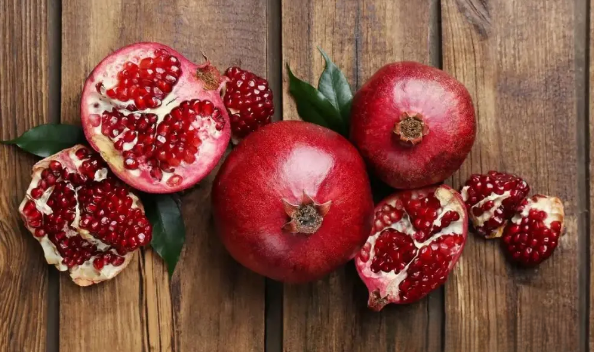
In 2005, the research team of scientist Cerd á first discovered the existence of urolithin A. Urolithin A (abbreviated as UA) is a metabolic product of gut microbiota, and its precursor tannic acid is abundant in various fruits such as pomegranate and strawberry.
In 2016, researchers from the University of Washington published a study in Nature Medicine showing that urolithin A can promote mitochondrial autophagy, extending the lifespan of Caenorhabditis elegans by 45%, becoming the first natural compound recognized by the scientific community to promote mitochondrial autophagy. In 2019, the first human clinical trial of urolith A showed its anti-aging effect, significantly increasing the level of fatty acid oxidation throughout the body, which is an important indicator of mitochondrial function.
Anti-aging And Anti-wrinkle Raw Materials
In 2023, research on urolithin is still ongoing. A study published in Nature Aging revealed that supplementing UA with food intake can reverse the aging characteristics of aging hematopoietic stem cells and restore their hematopoietic capacity. This aging reversal process is directly related to the mitochondrial autophagy mechanism activated by UA.
UA essentially acts as an autophagy inducer, mainly participating in and regulating mitochondrial autophagy processes through two pathways:
PINK1/Parkin ubiquitin dependent pathway
In the ubiquitin dependent pathway of mitochondrial autophagy, the PINK1 protein recognizes the target mitochondria and recruits and phosphorylates the ubiquitin binding protein Parkin, jointly promoting ubiquitination of mitochondrial proteins, amplifying autophagy signals, and "rushing" towards phagocytic cells. UA upregulates the levels of PINK1 and Parkin proteins by activating associated gene expression, promoting mitochondrial autophagy.
Receptor direct activation pathway
In addition to relying on the PINK1/Parkin pathway, mitochondria can also "switch pathways" to utilize certain receptor proteins (such as BNIP3), directly activating autophagy processes. UA, on the other hand, "remains steadfast and stable," upregulating receptor protein expression levels, making it easier for them to aggregate on the surface of mitochondria.
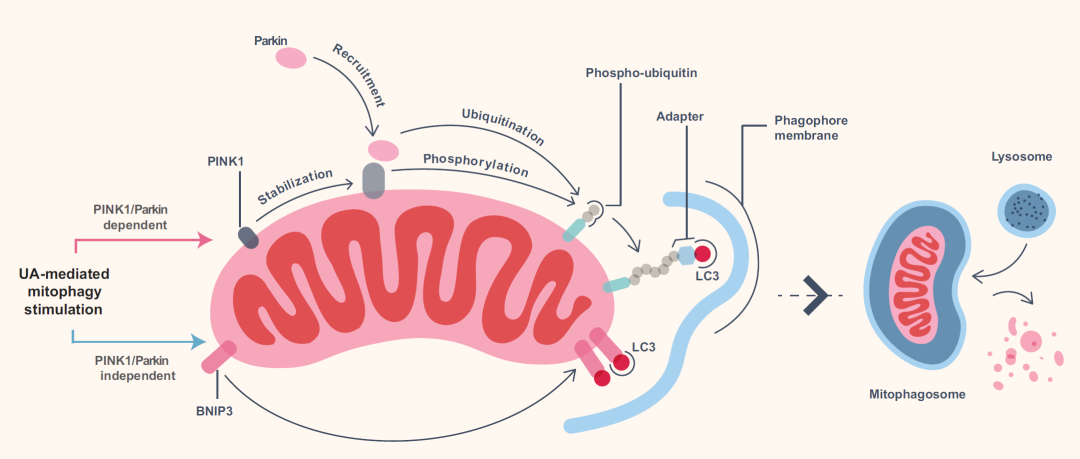
The role of UA
Anti-oxidant Raw Material
Among all urolith metabolites, UA has the strongest antioxidant activity, second only to proanthocyanidin oligomers, catechins, epicatechins, and 3,4-dihydroxyphenylacetic acid. Oxygen radical absorption capacity (ORAC) testing was performed on the plasma of healthy volunteers, and it was found that after consuming pomegranate juice for 0.5 hours, its antioxidant capacity increased by 32%, but the level of reactive oxygen species did not show significant changes. In Neuro-2a cell in vitro experiments, it was found that UA could reduce the level of reactive oxygen species in cells. Belcaro et al. found that the main active metabolite of the compound Robuvit is UA ® It can reduce the level of oxidative stress in patients, thereby improving their mood, fatigue, and insomnia. These results indicate that UA has strong antioxidant activity.
Anti-inflammatory effect
Aging is characterized by chronic inflammation throughout the body, accompanied by cellular aging, immune aging, and age-related diseases. The anti-inflammatory effect of UA may be one of the key mechanisms underlying its potential anti-aging effects. Specifically, UA can inhibit the nuclear factor kappa B (NF - κ B) and Akt/mitogen activated protein kinase (MAPK) signaling pathways, further reducing the production of inflammatory mediators by lowering the mRNA and protein levels of cyclooxygenase-2 (COX-2). In addition, UA can regulate the production of cytokines, reduce the production of pro-inflammatory cytokines such as tumor necrosis factor alpha (TNF - α), and enhance the synthesis of anti-inflammatory cytokines such as interleukin-10 (IL-10) and the expression of transforming growth factor beta 1 (TGF - β 1).
Improving obesity
UA can also reduce the accumulation of fat in adipocytes and liver cells cultured in vitro, increase fat oxidation, and convert T4, which is less active in thyroid hormone, into T3, which is more active. Through thyroid hormone signaling, it enhances metabolic rate and thermogenesis, thereby playing a role in controlling obesity.
Neuroprotection
UA, as a neuroprotective agent, can effectively combat neurodegenerative diseases caused by oxidative stress and abnormal protein aggregation, such as Alzheimer's disease and Parkinson's disease. These lesions initiate neuroinflammation by inducing cell apoptosis, and the pro-inflammatory cytokines released by the latter further drive neurodegeneration. The neuroprotective effect of UA is mainly achieved through the following pathways: firstly, inducing autophagy; The second is to activate the deacetylation mechanism of silencing information regulatory factor 1 (SIRT-1), mediating its anti-inflammatory activity, thereby inhibiting neuroinflammation and neurotoxicity; The third is to directly eliminate free radicals; The fourth is to inhibit the activity of oxidase.
Eye protection
On January 27, 2024, Nautre Communications published an article titled "Mitophagy Curtails Cytotoxic mtDNA Dependent Activation of cGAS/STING Inflammation During Aging". Mitochondrial autophagy inducer UA can reduce oxidative stress in aging retina; Reduced the level of cytoplasmic cGAS in the elderly retina and decreased the activation of glial cells.
Skin Care
Among all discovered mammalian intestinal metabolites, UA has the strongest antioxidant activity, second only to proanthocyanidin oligomers, catechins, epicatechins, and 3,4-dihydroxyphenylacetic acid.
Summary
Urolithin A, with its dual core mechanism of targeting mitochondrial autophagy and rhythm regulation, has demonstrated multidimensional value in the field of anti-aging, from cell repair to system function enhancement. However, its clinical translation still needs to overcome bottlenecks such as microbiota dependence, long-term safety validation, and cost optimization.