

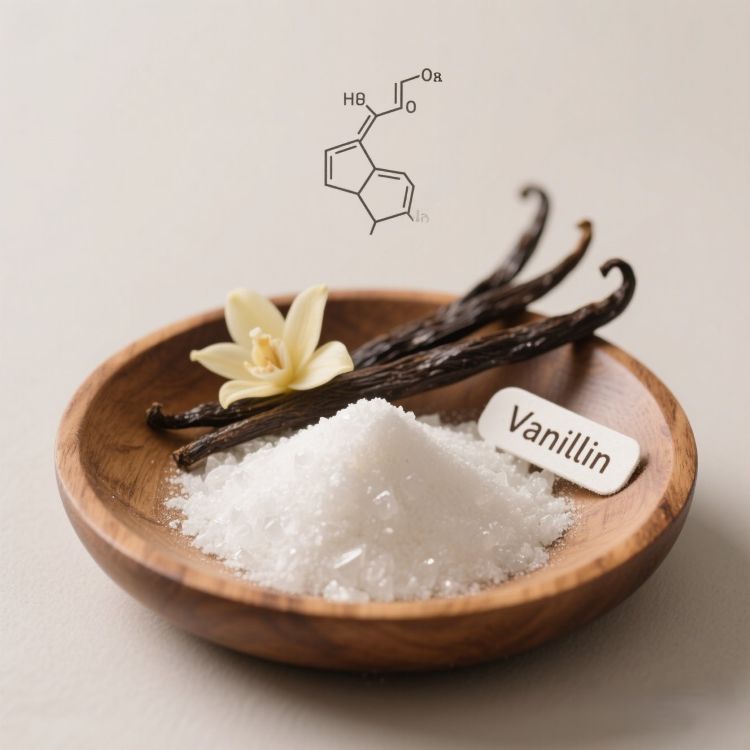
Application of Vanillin in Food Storage and Preservation
1. Antibacterial ingredients
Vanillin is often combined with other antibacterial methods in the food industry, and its antibacterial effect on different bacterial strains varies.
Moon et al. demonstrated that the antibacterial effect of vanillin is related to its concentration and pH value. Both higher vanillin concentration and lower pH value are beneficial for improving the antibacterial effect of vanillin. Vanillin has different antibacterial effects on different bacterial species, and compared with other bacterial species, it has a better antibacterial effect on Escherichia coli. Vanillin has inhibitory effects on various yeast species, and high concentrations of vanillin are beneficial for improving its antibacterial effect, but high concentrations of vanillin cannot immediately kill yeast.
Composite preservation realizes the synergistic effect between preservatives (or preservation methods), which is a widely accepted method for fruit and vegetable preservation. The antibacterial effect of spices often has a synergistic effect and the dosage is smaller than that of single use. For example, to prevent contamination by Aspergillus niger, the effective bactericidal dose of vanillin alone is 0.5% (mass fraction, the same below), while a mixture of 0.05% vanillin and 0.0025% cinnamaldehyde can exert bactericidal effect.
Vanillin also plays an important role in assisting in antibacterial and bactericidal activities. In the current production process, heat sterilization is still the most common sterilization method in juice processing, and its processing methods are generally pasteurization and high-temperature instantaneous sterilization.
Traditional sterilization methods often lead to the destruction of nutrients in fruit juice and browning of products. GastSlum et al. investigated the inactivation of bacterial strains using low-frequency ultrasound technology, temperature, and the amount of vanillin added as the main research factors. The results showed that the combination of low-frequency ultrasound technology, temperature, and vanillin effectively increased the inactivation rate of bacterial strains. Within the temperature range of 45-55 ℃, there was a significant reduction in Listeria incoca, and this sterilization method still has great research value in industry.
2. Anti-oxidant raw material
The mechanism of action of structurally similar antioxidants differs. Vanillin mainly accelerates the clearance of free radicals through the oxidation product vanillic acid. Vanillin's antioxidant effect can significantly extend the shelf life of oily foods and mask their rancid taste.
The isomer of vanillin, ortho vanillin (2-hydroxy-3-methoxybenzaldehyde), has been shown to have the ability to scavenge peroxynitrite anions, but it is not a very good free radical scavenger.
3. Stabilize other ingredients in food
Yuan Lingfang and others added vanillin to natural spices, proving that without changing the chemical composition of osmanthus essential oil, vanillin effectively delayed the volatilization of osmanthus essential oil, improving food quality and promoting the application of osmanthus essential oil in the food industry.
Previous studies have shown that the reaction products of vanillin help stabilize other components in food. Resveratrol is a natural functional ingredient, and in order to improve its stability and fully exert its functional effects, a network of chitosan microspheres formed by the reaction of vanillin and chitosan are used to encapsulate resveratrol, which helps to control its release; The condensation product of vanillin and amino groups has a good ability to complex with metal ions, which can effectively improve the stability of the encapsulated substances.
The safety of vanillin and issues worth studying in its application
Vanillin is a natural plant ingredient and is widely recognized as safe food additives. Due to its small dosage in food, there have been no reports of harmful effects of vanillin on the human body so far.
Vanillin has functions such as enhancing fragrance, inhibiting bacteria, antioxidation, and stabilizing food ingredients. It is a natural food additives with multiple functions, and can exert multiple effects at low doses.
Srinivasan et al. demonstrated that vanillin is also a beneficial active substance for health. After daily dietary intake, vanillin can effectively reduce the levels of serum triglycerides and triglycerides bound to various lipoproteins in experimental mice. Moreover, the effective lipid-lowering effect of vanillin is consistent with its small amount added to food as a food additive. Therefore, the low dosage and beneficial health properties of vanillin are the basis for its safety in use.
However, the addition of vanillin may also have adverse effects on the preservation of fruits and vegetables, which is the main problem in the application of vanillin and a problem worthy of our research.
According to Sangsuwan et al., pineapples coated with vanillin film stored at 10 ℃ showed a rapid decrease in VC content, which was lower than that of the control group. Although vanillin treatment could enhance the yellow color of pineapples, it resulted in a loss of nutrients while increasing the attractiveness of the fruit appearance.
In addition, due to its strong milky aroma and instability when exposed to heat, adding vanillin to food can also affect the inherent aroma of the food ingredients.
In production, the amount of vanillin added should be strictly controlled according to the actual situation, and the production processing technology and operation should be strictly standardized to avoid adverse effects on the sensory quality of food.
For how to effectively avoid the problems caused by the characteristics of vanillin itself, it is necessary to conduct in-depth research on its mechanism of action, processing technology, and other aspects.