

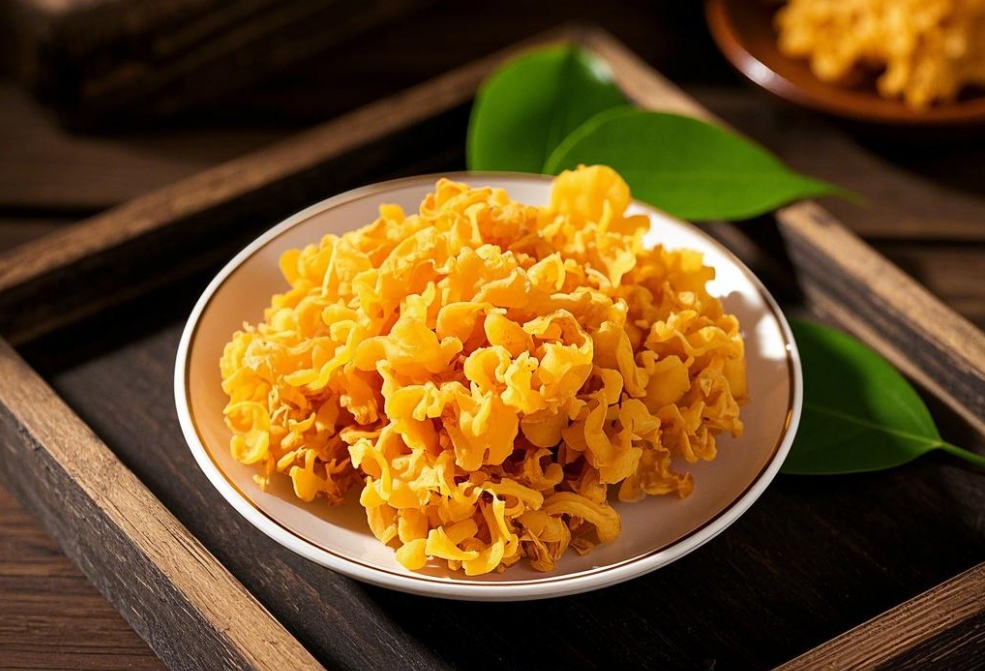
During the growth and fruiting process of golden ear mushrooms, fungi such as Lederma tricholoma are needed as companion mycelium. Lederma tricholoma and golden ear mycelium form a symbiotic body and develop together to form golden ear fruiting bodies. Due to the restriction of specific biological factors (companion Lederma tricholoma), the nutritional requirements and growth conditions of golden ear mushrooms are relatively complex, which limits the large-scale cultivation and production of golden ear mushrooms.
Skin care effects of golden ear
Mushrooms extract, golden ear polysaccharide is a natural moisturizer, which plays a very important role in improving the moisturizing effect of cosmetics. The degradation products of golden ear polysaccharide can significantly promote the synthesis of more water channel proteins and tight junction proteins in epidermal keratinocytes, showing good water absorption and water retention, and significant moisturizing effect. At the same time, golden ear fermentation liquid polysaccharide also has a certain reducing ability and strong scavenging DPPH and hydroxyl free radical activity.
Nowadays, golden ear has become a new raw material for cosmetics, which means that this precious fungus with golden color is not only a delicacy in traditional Chinese cuisine, but also a natural bridge connecting food and beauty, interpreting the deep connotation of "makeup and food are of the same origin".
More benefits of Tremella fuciformis
Tremella fuciformis polysaccharides are the main biologically active ingredients of Tremella fuciformis, accounting for 37.8%-40.55%. Tremella fuciformis fruiting bodies and mycelium both contain a large amount of polysaccharides. Tremella fuciformis fruiting bodies polysaccharides are composed of mannose, glucose, rhamnose, xylose, and glucuronic acid, while mycelium polysaccharides are composed of glucose, mannose, galactose, fucose, and rhamnose. Tremella fuciformis also contains a large amount of protein and amino acids, with contents of about 12% and 10%, respectively. Amino acids mainly include isoleucine, leucine, lysine, alanine, etc. In addition, Tremella fuciformis is rich in sulfur, phosphorus, manganese, iron and other trace elements. These nutrients have strong effects on improving the body's metabolic function, anti-aging, anti-oxidation raw material, lowering blood lipids, lowering cholesterol, promoting liver lipid metabolism, and improving liver detoxification function.
Blood sugar reduction: Experiments have shown that continuous gavage of Tremella fuciformis fruiting bodies for three weeks in SD rats with hyperglycemia induced by alloxan can effectively reduce the high blood sugar level of SD rats and significantly reduce the concentration of glycosylated plasma proteins in rats. In addition, by exploring the hypoglycemic effect of Tremella fuciformis polysaccharides on diabetic mice induced by alloxan, it was found that the mycelial polysaccharides significantly improved the weight of mice. The mechanism may be that it inhibits the activity of glucose-6-phosphatase in gluconeogenesis, thereby inhibiting glycogen production and lowering blood sugar.
Liver protection: Studies have found that after feeding polysaccharides extracted from Tremella fuciformis fruiting bodies or mycelium to rats with excessive liver fat for 8 weeks, total liver lipids and liver cholesterol decreased by 55% and 50%, respectively, and serum alanine aminotransferase was significantly reduced. It has a protective and restorative effect on acute and chronic liver poisoning caused by carbon tetrachloride, indicating that Tremella fuciformis has a good lipid-lowering and liver-protecting effect.
Anti-asthma: Chinese medicine classics mention that Tremella fuciformis can improve diseases such as lung heat and phlegm, colds and coughs, and asthma. The polysaccharides extracted from the fruiting bodies of Tremella fuciformis can reduce and inhibit airway inflammation in asthmatic rats, and have a significant protective effect on the delayed phase of the rat allergic asthma model. In addition, Tremella fuciformis polysaccharides were also found to have a significant protective effect on rapid-onset allergic asthma in the guinea pig allergic asthma model.
Enhance immunity: Tremella fuciformis polysaccharides may exert immunostimulatory activity through Toll-like receptor 4 (TLR4) on the surface of macrophages. In terms of cytokine regulation, Tremella fuciformis polysaccharides can promote the secretion of cytokines such as interferon-γ (IFN-γ) and interleukin-2 (IL-2), and regulate the Th1/Th2 immune balance. This multi-target immunomodulatory effect makes Tremella fuciformis of great value in enhancing the body's resistance and preventing infectious diseases.